
EigenLayer Restaking Guide: Earn Extra Yield on Your Staked ETH
Last Updated: January 2026
EigenLayer has emerged as one of the most significant innovations in Ethereum’s staking ecosystem, currently securing $18-20 billion in Total Value Locked (TVL). This massive adoption reflects the protocol’s potential to fundamentally transform how blockchain security works while offering stakers additional yield opportunities on their already-staked ETH.
However, with greater rewards come greater risks. This comprehensive EigenLayer restaking guide will walk you through everything you need to know: how the protocol works, the various restaking methods available, the critical risks you must understand, and step-by-step instructions for getting started.
IMPORTANT RISK WARNING: Restaking through EigenLayer introduces additional risks beyond traditional Ethereum staking. Slashing events can result in the loss of up to 100% of your restaked assets. This guide is for educational purposes only and does not constitute financial advice. Always conduct your own research and consider consulting with a financial advisor before participating in any DeFi protocols.
What is Restaking? A Simple Explanation
To understand restaking, let’s first review traditional staking. When you stake ETH on Ethereum, you’re essentially putting up collateral to help secure the network. Validators who behave honestly earn rewards; those who act maliciously or negligently can have their stake “slashed” (partially or fully confiscated).
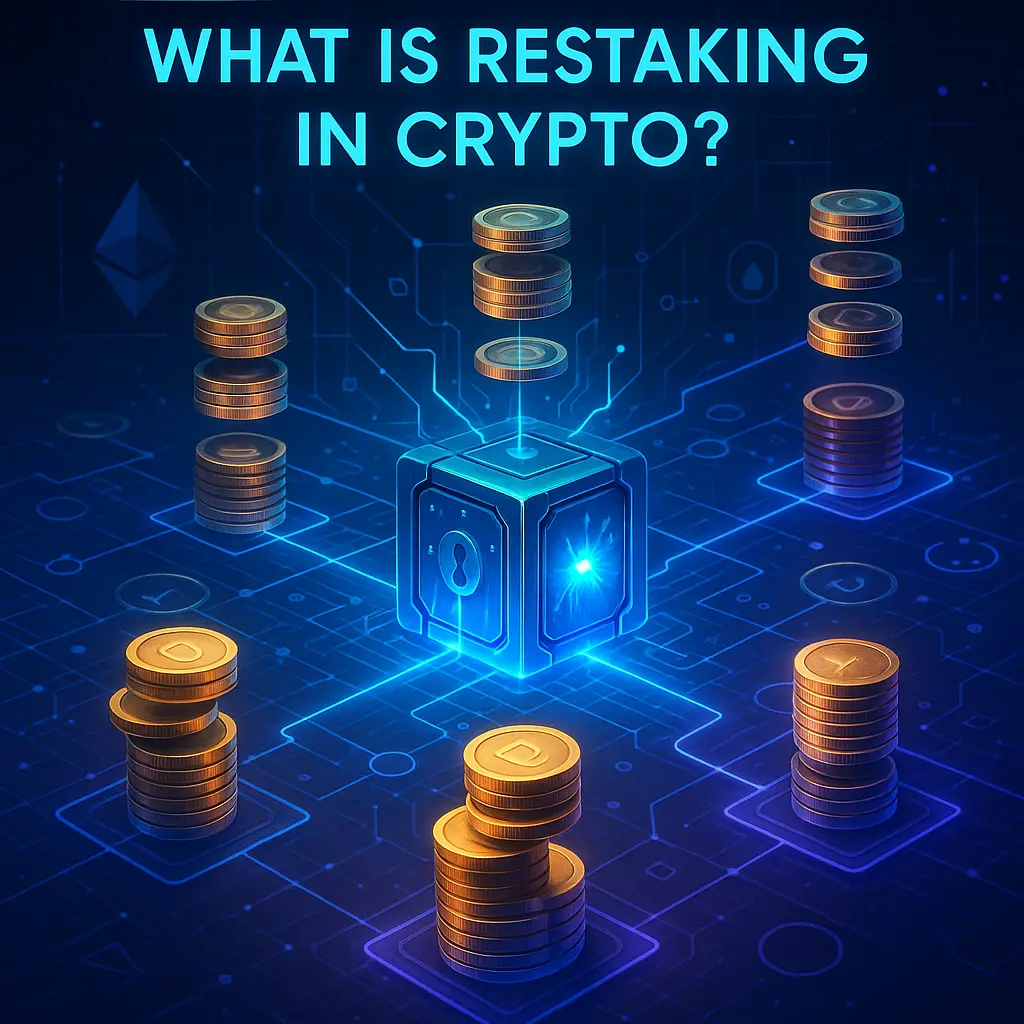
Restaking takes this concept one step further: it allows you to use your already-staked ETH to simultaneously secure additional protocols and services, earning extra rewards in the process.
The Security Guard Analogy
Think of it like this: Imagine you’re a security guard at a bank. You’ve put up a bond (your stake) guaranteeing your honest behavior. The bank pays you for your services.
Now, imagine the jewelry store next door also needs security. Instead of hiring a completely new guard and requiring a separate bond, they ask if you’d be willing to extend your services to them as well. You’re already there, already bonded, and already proven trustworthy. By agreeing to also watch the jewelry store, you earn additional income while your original bond now secures both establishments.
That’s restaking in a nutshell. Your staked ETH (the bond) can secure multiple services simultaneously, and you earn rewards from each one.
How EigenLayer Works: The Core Concept
EigenLayer is the protocol that makes restaking possible on Ethereum. At its core, it creates a marketplace where:
- Stakers can opt-in to restake their ETH to secure additional services
- Operators run the infrastructure that validates these services
- Actively Validated Services (AVSs) are the protocols that need security
Pooled Security: EigenLayer’s Innovation
Before EigenLayer, every new blockchain service that needed security had to bootstrap its own validator set and economic security from scratch. This was expensive, time-consuming, and resulted in fragmented security across the ecosystem.
EigenLayer introduces pooled security: the massive economic security of Ethereum’s staked ETH (over $100 billion) can be extended to secure other protocols. This benefits everyone:
- New protocols get access to battle-tested, economically robust security without building from zero
- Stakers earn additional yield on their existing stake
- The ecosystem becomes more interconnected and capital-efficient
However, this interconnection also means that risks are shared. If a staker’s assets are used to secure a service that experiences issues, those assets can be slashed.
Restaking Methods: Three Ways to Participate
EigenLayer offers multiple pathways for restaking, each with different requirements, complexity levels, and risk profiles.
1. Native Restaking
Native restaking is for users who run their own Ethereum validators. This method involves:
- Running a full Ethereum validator node (requires 32 ETH minimum)
- Pointing your validator’s withdrawal credentials to an EigenPod (a smart contract)
- Opting into AVSs through EigenLayer’s operator system
Pros: Most direct method, no intermediary risk, full control
Cons: High barrier to entry (32 ETH + technical expertise), requires ongoing maintenance
2. Liquid Restaking via LSTs
Liquid Staking Tokens (LSTs) like stETH (Lido), rETH (Rocket Pool), and cbETH (Coinbase) can be deposited directly into EigenLayer. This method:
- Allows participation with any amount of LSTs
- No need to run validator infrastructure
- Maintains the liquidity benefits of LSTs
Pros: Lower barrier to entry, no technical requirements
Cons: Subject to deposit caps, additional smart contract risk from the LST protocol
3. The EIGEN Token
EigenLayer has introduced its native EIGEN token, which can be staked to secure AVSs. The EIGEN token introduces a novel concept called “intersubjective staking,” designed to handle faults that can’t be proven on-chain but are clearly observable off-chain.
Pros: Participates in protocol governance, different security model
Cons: Token price volatility, separate from ETH restaking rewards
What are AVSs (Actively Validated Services)?
Actively Validated Services are the protocols that leverage EigenLayer’s restaked security. These are the “jewelry stores” in our earlier analogy – the services that benefit from Ethereum’s pooled security.
Definition
An AVS is any system that requires its own distributed validation semantics for verification. In simpler terms, it’s any service that needs a network of operators to validate its operations and is willing to pay for that security.
Examples of AVSs
Oracles: Decentralized oracle networks that provide external data to smart contracts. Restaked security ensures data providers remain honest.
Data Availability Layers: Services like EigenDA that ensure transaction data remains available for verification. Critical for rollups and Layer 2 solutions.
Bridges: Cross-chain bridges that transfer assets between blockchains. Security is paramount as bridges have historically been major hack targets.
Sequencers: Decentralized sequencers for rollups that order transactions fairly and resist censorship.
Keeper Networks: Automated services that execute smart contract functions when certain conditions are met.
Coprocessors: Off-chain computation services that extend smart contract capabilities.
As the EigenLayer ecosystem matures, dozens of AVSs are launching, each offering different reward structures and risk profiles.
Rewards Structure: Where Does the Yield Come From?
Understanding where restaking rewards originate is crucial for evaluating whether the additional yield justifies the additional risk.
Sources of Rewards
AVS Payments: The primary source of restaking rewards. AVSs pay operators (and by extension, stakers) for providing security. These payments may be in:
- The AVS’s native token
- ETH
- Stablecoins
- A combination of the above
EIGEN Token Incentives: EigenLayer may distribute EIGEN tokens as additional incentives for early participants and to bootstrap adoption.
LRT Protocol Incentives: Liquid Restaking Token protocols often provide their own token incentives on top of base restaking rewards.
Typical APY Ranges
Restaking yields are highly variable and depend on multiple factors:
- Base Ethereum Staking: 3-4% APY
- EigenLayer Restaking Premium: Additional 1-5% APY (varies significantly)
- LRT Protocol Incentives: Additional 2-10%+ (often temporary, in protocol tokens)
YIELD WARNING: Extremely high advertised APYs (20%+) typically include temporary token incentives that may decrease over time or lose value. Do not chase yield without understanding the underlying sources and risks. Sustainable restaking yields are likely in the 5-10% range once the ecosystem matures.
Risks: What Can Go Wrong
This section is the most important part of this EigenLayer restaking guide. The additional yield from restaking comes with proportionally higher risks. Understanding these risks is non-negotiable before participating.
1. Slashing Risk – CRITICAL
CRITICAL WARNING: Slashing can result in the COMPLETE LOSS (100%) of your restaked assets.
When you restake, you’re agreeing to have your assets slashed if the operators securing your chosen AVSs misbehave or fail to meet their obligations. This slashing is in addition to standard Ethereum staking slashing risks.
Key slashing considerations:
- Different AVSs have different slashing conditions
- Slashing severity varies – some may slash a percentage, others may slash 100%
- You are exposed to slashing risk for every AVS your chosen operator validates
- Operator mistakes (not just malicious behavior) can trigger slashing
2. Smart Contract Risk
EigenLayer introduces multiple layers of smart contracts:
- EigenLayer core contracts
- EigenPod contracts (for native restaking)
- AVS-specific contracts
- LRT protocol contracts (if using liquid restaking tokens)
Each layer represents a potential attack surface. While major protocols undergo audits, no smart contract is guaranteed to be bug-free.
3. Operator Risk
Your assets are entrusted to operators who run the validation infrastructure. Risks include:
- Operator incompetence leading to slashing
- Operator malicious behavior
- Operator becoming insolvent or disappearing
- Technical failures in operator infrastructure
4. Liquidity Risk
Depending on your restaking method:
- Native restaking may have unbonding periods
- LRT tokens may trade at discounts to their underlying value during stress
- During market panic, exiting positions may be difficult or costly
5. Regulatory Risk
The regulatory landscape for staking and restaking continues to evolve. Future regulations could impact:
- The legality of restaking services in certain jurisdictions
- Tax treatment of restaking rewards
- Operator and protocol compliance requirements
6. AVS-Specific Risks
Each AVS you secure has its own risk profile. A vulnerability or failure in any AVS could result in slashing for all stakers securing it.
How to Restake: Step-by-Step Guide
There are three main approaches to restaking, ranging from simple to complex.
Method 1: Via Liquid Restaking Tokens (LRTs) – Easiest
Liquid Restaking Tokens abstract away much of the complexity. Popular LRTs include:
- eETH (Ether.fi) – The largest LRT by TVL
- ezETH (Renzo) – Popular for its point system and DeFi integrations
- pufETH (Puffer Finance) – Focuses on anti-slashing technology
- rsETH (Kelp DAO) – Multi-LST restaking approach
Step-by-step process:
- Prepare your wallet: Ensure you have ETH or an LST (like stETH) in a compatible wallet (MetaMask, etc.)
- Visit the LRT protocol: Go to the official website of your chosen LRT (e.g., ether.fi, renzoprotocol.com)
- Connect your wallet: Click “Connect Wallet” and approve the connection
- Deposit ETH or LST: Enter the amount you wish to restake and confirm the transaction
- Receive LRT tokens: You’ll receive LRT tokens (eETH, ezETH, etc.) representing your restaked position
- Optional – Use in DeFi: LRTs can often be used in DeFi protocols for additional yield (adds more risk)
TIP: Always verify you’re on the official protocol website. Bookmark official URLs and never click links from social media or emails.
Method 2: Direct LST Deposit to EigenLayer
Step-by-step process:
- Acquire LSTs: Obtain stETH, rETH, or other supported LSTs through their respective protocols
- Visit EigenLayer: Go to the official EigenLayer application (app.eigenlayer.xyz)
- Connect wallet: Connect your wallet containing the LSTs
- Check deposit availability: LST deposits may have caps; check if deposits are open
- Deposit LSTs: Select your LST, enter the amount, and confirm the transaction
- Delegate to an operator: Choose an operator to delegate your restaked assets to
Method 3: Native Restaking – Most Complex
Requirements:
- 32 ETH minimum
- Technical expertise to run validator infrastructure
- Reliable hardware and internet connection
High-level process:
- Set up an Ethereum validator: This requires running execution and consensus layer clients
- Create an EigenPod: Through the EigenLayer app, create your EigenPod contract
- Set withdrawal credentials: Configure your validator’s withdrawal credentials to point to your EigenPod
- Verify withdrawal credentials: Complete the verification process in the EigenLayer app
- Delegate to operator: Choose an operator or operate your own node
Due to the complexity and high stakes involved, native restaking should only be attempted by those with significant technical expertise or through professional staking services.
Choosing an Operator: Critical Considerations
Your choice of operator significantly impacts both your rewards and your risk exposure.
Factors to Evaluate
Track Record: How long has the operator been active? What is their historical performance?
AVS Selection: Which AVSs does the operator validate? More AVSs means more potential rewards but also more slashing exposure.
Technical Infrastructure: Does the operator have robust, redundant infrastructure? What is their uptime history?
Reputation: Is the operator a known, reputable entity? Are they doxxed or anonymous?
Commission Rate: What percentage of rewards does the operator keep? Balance between low fees and quality service.
Transparency: Does the operator clearly communicate their operations, risks, and any incidents?
Where to Find Operator Information
- EigenLayer’s official operator registry
- Independent analytics platforms tracking operator performance
- Protocol forums and community discussions
- Operator’s own documentation and disclosures
Best Practices for Restaking
Position Sizing
RECOMMENDED EXPOSURE: 5-25% of your total ETH holdings
Given the additional risks of restaking, conservative position sizing is essential. Never restake more than you can afford to lose entirely.
Position sizing considerations:
- Conservative (5-10%): For those new to restaking or with lower risk tolerance
- Moderate (10-15%): For experienced DeFi users who understand the risks
- Aggressive (15-25%): Only for those who fully understand all risks and can absorb significant losses
- Above 25%: Generally not recommended due to concentration risk
Diversification Strategies
Across LRTs: Don’t put all restaked assets into a single LRT protocol. Spread across 2-3 reputable LRTs.
Across Operators: If possible, delegate to multiple operators with different AVS exposures.
Across Methods: Consider using a mix of direct restaking and LRTs.
Ongoing Management
- Regularly monitor your positions and operator performance
- Stay informed about new AVSs and their risk profiles
- Be prepared to exit if risk parameters change unfavorably
- Keep detailed records for tax purposes
Comparison: Regular Staking vs. EigenLayer Restaking
| Factor | Regular ETH Staking | EigenLayer Restaking |
|---|---|---|
| Typical APY | 3-4% | 5-10%+ (variable) |
| Slashing Risk | Low (Ethereum consensus only) | Higher (Ethereum + all AVSs) |
| Maximum Loss | Partial (typically up to 50%) | Up to 100% |
| Smart Contract Layers | 1-2 (LST protocol) | 3-5 (LST + EigenLayer + AVS + LRT) |
| Complexity | Low to Medium | Medium to High |
| Minimum Investment | Any amount (via LSTs) | Any amount (via LRTs) |
| Liquidity | Good (LSTs tradeable) | Variable (depends on method) |
| Track Record | Years (since 2020) | Limited (since 2023) |
| Operator Dependency | Low | High |
| Recommended For | Most ETH holders | Risk-tolerant, experienced users |
Frequently Asked Questions (FAQ)
What is the minimum amount needed to restake on EigenLayer?
Through Liquid Restaking Tokens (LRTs), there is no practical minimum – you can restake with as little as a few dollars worth of ETH. Direct LST deposits to EigenLayer may have higher minimums during capped periods. Native restaking requires the full 32 ETH validator minimum.
Can I lose all my restaked ETH?
Yes. In the worst-case scenario, slashing events could result in the loss of 100% of your restaked assets. This is one of the most critical risks to understand before participating.
How is restaking different from liquid staking?
Liquid staking (like Lido’s stETH) allows you to stake ETH and receive a tradeable token while earning Ethereum staking rewards. Restaking takes this further by using that staked ETH to secure additional services (AVSs) for additional rewards – but with additional slashing risk.
What happens if an AVS gets hacked?
Depending on the nature of the incident and the AVS’s slashing conditions, restakers securing that AVS could face slashing. The severity depends on the specific circumstances and the AVS’s slashing parameters.
How do I know which AVSs my operator is validating?
This information should be available through EigenLayer’s operator registry and the operator’s own disclosures. Always verify this before delegating, as it directly impacts your risk exposure.
Are restaking rewards taxable?
In most jurisdictions, yes. Restaking rewards are typically treated as income when received. However, tax treatment varies by country and your specific circumstances. Consult a tax professional familiar with cryptocurrency.
Can I unstake at any time?
Unstaking typically involves a waiting period (unbonding period) that varies by method. LRTs may offer more immediate liquidity through trading, though potentially at a discount during market stress.
What is an EigenPod?
An EigenPod is a smart contract created for native restakers that receives validator withdrawal credentials. It’s the mechanism that allows EigenLayer to account for and potentially slash natively restaked ETH.
Should I restake all my staked ETH?
No. Due to the additional risks, it’s recommended to restake only 5-25% of your ETH holdings. Maintain diversification between regular staking and restaking.
What’s the difference between EigenLayer and LRT protocols like Ether.fi?
EigenLayer is the underlying protocol that enables restaking. LRT protocols like Ether.fi, Renzo, Puffer, and Kelp are built on top of EigenLayer to provide a more user-friendly restaking experience with liquid tokens.
Conclusion
EigenLayer represents a significant innovation in blockchain security and capital efficiency, offering the potential for enhanced yields on staked ETH. With $18-20 billion in TVL, the protocol has demonstrated substantial market adoption.
However, this EigenLayer restaking guide has emphasized throughout that these additional rewards come with proportionally higher risks. The possibility of 100% slashing, multiple smart contract layers, operator dependencies, and the relative newness of the technology all demand careful consideration.
For those who decide to participate, the key principles are:
- Position sizing: Limit restaking to 5-25% of ETH holdings
- Diversification: Spread across multiple LRTs and operators
- Due diligence: Research operators and understand AVS risks
- Ongoing monitoring: Stay informed and be prepared to adjust
Restaking is not suitable for everyone. Those seeking stable, lower-risk staking yields may be better served by traditional Ethereum staking through established liquid staking protocols. Only those who fully understand and accept the risks should consider restaking as part of a diversified approach to ETH staking.
FINAL RISK REMINDER: This article is for educational purposes only and does not constitute financial, investment, or legal advice. Restaking involves significant risks including the potential for total loss of funds. Always conduct your own research, understand all risks involved, and consider seeking professional advice before participating in any DeFi protocols. Never invest more than you can afford to lose.